DJ SHADOW: The Man Who Built a Cathedral Out of Other People's Records
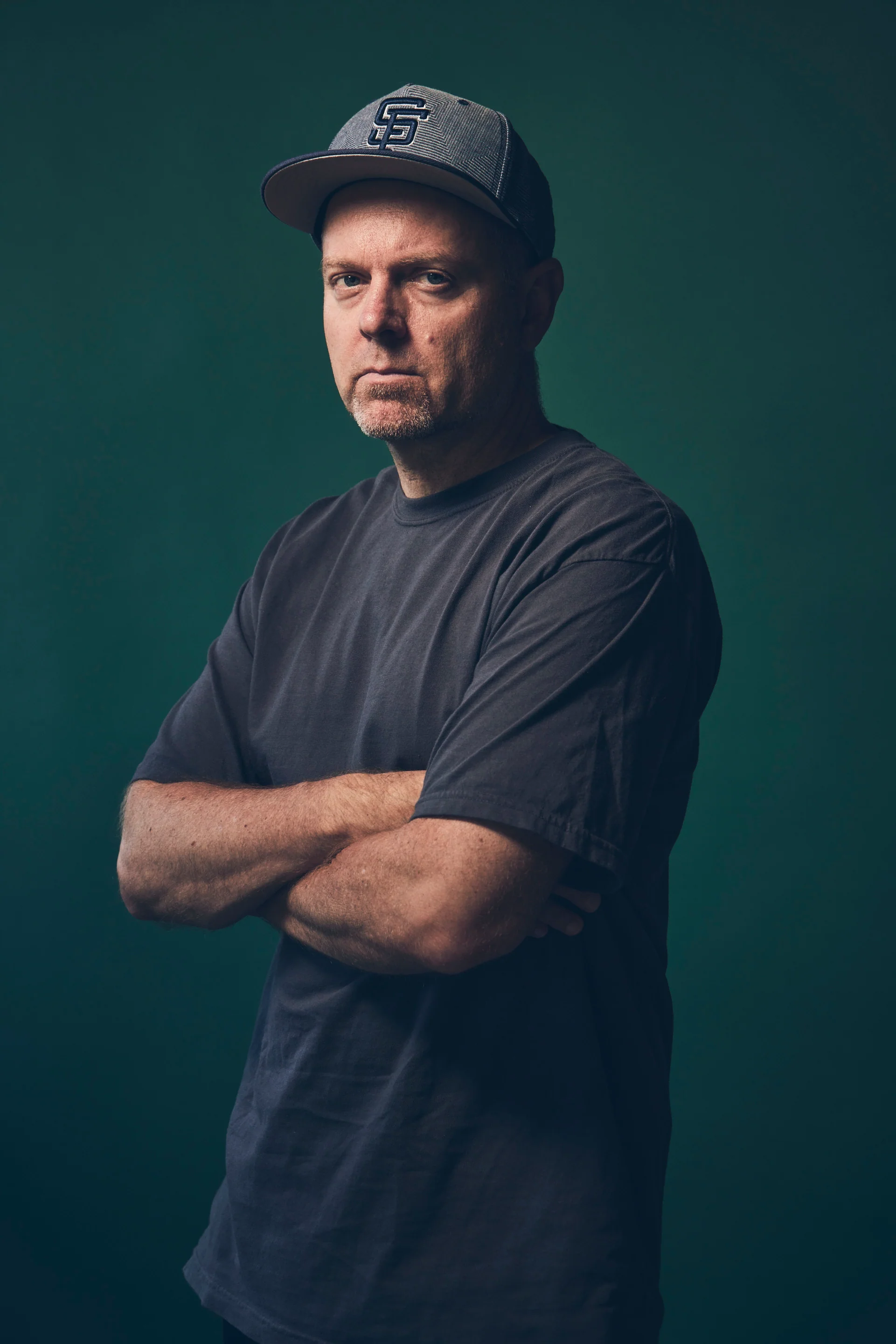
Consider the humble vinyl record. A flat black disc, roughly the diameter of a dinner plate, capable of holding — what — forty minutes of music? Now consider Joshua Paul Davis, born June 29, 1972, in San Jose, California, who owns more than 60,000 of them. Sixty thousand. If you stacked them, they'd — well, let's just say you'd need planning permission. A small tower made entirely of other people's music. Which is either hoarding or the most beautiful research library ever assembled, and with Josh Davis it has always been both.
He started, as all the best obsessives do, small. A kid in the college town of Davis, California — yes, the town shares his name; no, I don't think it's a coincidence, cosmically speaking — messing around with a four-track recorder in high school, inspired by Public Enemy's It Takes a Nation of Millions to Hold Us Back, which taught a generation that a sampler was an instrument and history was raw material. He DJ'd at the UC Davis campus station KDVS, co-founded the Solesides label with his fellow travelers (including future underground heroes Blackalicious and Lyrics Born), and in 1991 landed in The Source's "Unsigned Hype" column, which in those days was essentially a golden ticket printed on newsprint.
Then came the 12"s — "In/Flux," "Lost and Found (S.F.L.)" — strange, gorgeous transmissions that floated across the Atlantic and landed on the desk of James Lavelle, the young impresario behind London's Mo' Wax label. Lavelle heard what the rest of us would soon hear: a kid making symphonies out of fragments. And so, in the summer of 1994, DJ Shadow began recording his debut album for Mo' Wax with an almost monastic setup: one Akai MPC60 sampler, one Technics SL-1200 turntable, one ADAT tape recorder. Three machines. That's it. The Sistine Chapel was painted with brushes; Endtroducing..... was built with three boxes and sixty thousand records' worth of memory.
When it arrived in late 1996, Endtroducing..... did something no album had ever done: it was constructed entirely from samples. Every kick, every snare, every mournful string swell, every half-heard voice — borrowed, excavated, recontextualized. It later entered the Guinness World Records as the first completely sampled album, which is the kind of fact that sounds made up until you remember it's true. And here's the miracle: it doesn't sound like a collage. It sounds like a place. "Midnight in a Perfect World," "Stem/Long Stem," "Building Steam with a Grain of Salt" — these are fully inhabited compositions, melancholy and cinematic, the sound of someone who went digging through the dollar bins of history and came back with ghosts.
(I have spent an embarrassing amount of time wondering about the cover photo, shot inside Rare Records in Sacramento, the very shop where so many of those samples were found. It's a portrait of the artist as a young crate-digger, surrounded by the raw material of his imagination. Most album covers are advertisements. This one is an origin story.)
What followed was a career-long refusal to repeat himself, which is the noblest and most commercially suicidal instinct an artist can have. He co-piloted UNKLE's Psyence Fiction (1998) — Thom Yorke! Richard Ashcroft! Mike D! Kool G Rap! — then swerved into the synth-pop shimmer of The Private Press (2002), the rock-and-rap restlessness of The Outsider (2006) and The Less You Know, The Better (2011), and the dark ambience of The Mountain Will Fall (2016). Some fans grumbled at every turn. The grumbling missed the point: Shadow was never a genre, he was a method. The method is curiosity.
And curiosity, it turns out, is ubiquitous. In a wonderful Stereogum interview, Shadow casually revealed that his music soundtracked the "next week on The Wire" previews — for, he thinks, multiple seasons. Let that sink in: one of the greatest television shows ever made reached for DJ Shadow when it needed to sound like dread, fate, and Baltimore at night. His fascination with dystopia — a thread running through four decades of work — turned out to be exactly what prestige TV needed. Elusive yet everywhere. That's the Shadow paradox in a sentence.
He's still at it, by the way. Still DJing, still producing, still running his Liquid Amber label (founded 2014), still, presumably, buying records at a rate that would concern a structural engineer. Nearly forty years into a career that began with a four-track and a radio slot, Josh Davis remains what he always was: a listener first, a builder second, and living proof that originality isn't about inventing new sounds — it's about hearing new connections in old ones.
Sixty thousand records. One imagination. Zero wasted samples.
Key sources: Wikipedia — "DJ Shadow"; Discogs — DJ Shadow artist page; Stereogum — "We've Got A File On You: DJ Shadow" (interview); Guinness World Records (first album made entirely from samples); The Current (Endtroducing 25th anniversary).